
The right choice of technology will make or break your capturing of spatial data. Be it construction, environmental monitoring, or urban planning, choosing between LiDAR and photogrammetry makes the difference. At iScano, we have hands-on experience in using various technologies and continue to bear witness to the respective strengths each has, some of the challenges coming to play more often in a real way.
Below, we’ll present the main differences, share first-hand experiences, and give expert opinions on our iScano team to help you make the right choice.

The iScano Perspective: Why This Debate Matters
Having deployed several LiDAR systems and some photogrammetry solutions in the last years, our team here at iScano has gained great prestige among a wide variety of industries. One such example is a big client who does large-scale urban planning in Miami, which did highly detailed mapping to analyze flood risks. While LiDAR gave the best form of accurate terrain, on the other side, photogrammetry made drawings of highly detailed visuals quite possible in the neighborhoods left affected. These two represent some of the essential paraphernalia that give actionable insights into.


Understanding LiDAR Technology: Light Detection and Ranging
Definition and Explanation of LiDAR
LiDAR is one advanced remote sensor that uses laser light to help in measuring distances and even the realization of high-resolution three-dimensional mapping of both objects and environments. It initiates technology by releasing laser pulses, which finally return to a sensor after the pulse has passed over surfaces. Then, by accurately calculating the distance traveled-through the measurement of the flying time of the laser light in its return-it gives a rather detailed point cloud, a set of data points representing the 3-D structure of the area that went through scanning.
LiDAR technology happens to be very versatile and hence can find its application in many diverse fields. Whether it be monitoring the environment, mapping the terrain hidden by dense vegetation, or perhaps LiDAR sensors onboard self-driving cars, quite pivotal for the vehicle in terms of real-time navigation and detection of obstacles for smooth, efficient, safe operations, place LiDAR systems. Accuracies and reliability: LiDAR systems become irreplaceable in rather a great number of applications concerning not only surveying and mapping but also beyond them.

How LiDAR Works
LiDAR basically works by sending out laser pulses that reflect from surfaces back to the sensor, hence a very efficient lidar for data acquisition. It calculates accurate distances by measuring the time it takes for the light to return. LiDAR systems can detect objects with high precision, something very important in applications such as autonomous driving and geographic information systems. It creates a very detailed point cloud, a set of data points representing the scanned area.
For instance, LiDAR, in one of our projects, helped us to create a map of the landscape beneath the canopy in the dense forest of Vermont so as to enable better planning for a new hiking trail. It could not have been as accurate with photogrammetry because it would be greatly interfered with by vegetation.
LiDAR Strengths and Applications
- High Accuracy in Terrain Mapping
Because LiDAR penetrates dense vegetation well, it is particularly good at monitoring environmental changes, making constructions, and conducting archaeological surveys. - Real Time Data in Autonomous Vehicles In our client base within the transport industry, LiDAR finds its application in safe navigation for driverless car models.
- Urban Development It was, for that matter, important that the elevation data be determined rightly by LiDAR, with the view to evaluating the flood risks emanating from an urban development project that arises in Miami.

Challenges of LiDAR
- High cost: The cost of LiDAR equipment and processing software is pretty expensive, hence inaccessible to projects of smaller scales.
- Specialized Skills: While LiDAR has many applications, most of those applications are real in effective expertise at the acquisition and processing of data and therefore rated to be the value addition that professionals will have, like those from the iScano team..
Demystifying Photogrammetry
Definition and Explanation of Photogrammetry
Photogrammetry is based on the extraction of information by automatic procedures from overlapping photographs for highly detailed three-dimensional models. It means that through the analysis of multiple images taken from various angles, it calculates the position and orientation of every image taken from an object or scene. This enables one to reconstruct a three-dimensional structure of an environment from two-dimensional images, applying principles of geometry and computer vision.
This technique finds great areas of application in domains like surveying and mapping, architecture, filmmaking, and so on. For example, photogrammetry gives a very precise 3D overview of buildings for architectural work and restorations in architecture. Similarly, when it comes to filmmaking, it helps in digital environments and special effects while producing realistically looking results. Capabilities to make photo-realistic detailed models open opportunities for many applications of photogrammetry.

How Photogrammetry Works
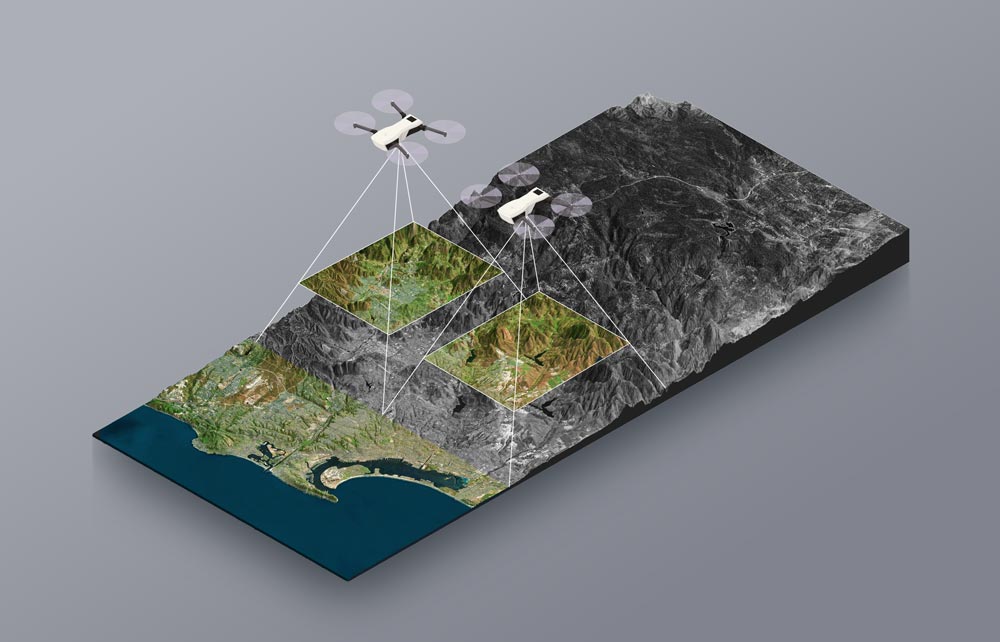
Photogrammetry is a way of building 3D models from 2D overlapping images taken from different viewpoints. With the help of drones or high-resolution cameras, it produces a very nice-looking digital representation. For example, photogrammetry helped our client document the façade of a historical building in the Art Deco District of Miami by preserving all the minute details for restoration.
Photogrammetry Strengths and Applications
- Cost-Effectiveness
Photogrammetry would be cost-effective, with the easy availability of drones and cameras useful for capturing these images from skies and grounds for projects of even the smallest to medium magnitude. - Visual Detail in Urban Planning
More recently, the iScano team used photogrammetry to create highly detailed models of a local park redevelopment project to help stakeholders see what the final design might look like. - Cultural Preservation
Photogrammetry today represents the most critical methodology not only for archaeological site documentation but also for historic landmark preservation.
Challenges of Photogrammetry
- Environmental Limitations: Photogrammetry heavily relies on the consistency of lighting and good weather; hence, it cannot be very well implemented in challenging environments.
- Low spatial accuracy: It is probably the case that photogrammetric methods do not perform in regard to LiDAR in a number of demanding terrains.
LiDAR vs. Photogrammetry: Key Differences
Data Collection and Processing
- LiDAR: High-resolution data collection in real time is a strong suit of this, particularly in conditions where light is low or vegetative interference is high.Photogrammetry is good for creating visually rich models but requires a great deal of post-processing in aligning images and generating data.

Accuracy Comparison
Both LiDAR and photogrammetry operate within different strengths concerning actual accuracy. LiDAR belongs to a class of really highly precise technologies; hence, the ranging accuracy is typically higher, lying in a bracket starting from 0.5 up to 10 mm relative to the sensor – the mapping accuracy is up to 1 cm horizontally and up to 2 cm vertically. This amount of detail will help in undertaking projects having considerable terrain analysis and modeling of infrastructure that requires minute details.
While it is theoretically capable and could provide, with the same elevation, horizontal accuracy as little as 1 centimeter, in general, photogrammetry does require special payloads and a very high degree of meticulous flight mission planning, complemented with tons of postprocessing to yield all that. For example, to provide highly detailed visuals by making use of photogrammetry in the documentation of a historic building, a great deal of painstaking attention was paid in the planning and execution of this work to the level of detail necessary in the final model.

Cost and Accessibility
While LiDAR systems are more of an investment, photogrammetry can provide most businesses with a lower barrier to entry. The lidar market is seeing very fast growth because of rapid technological development and huge investments, especially in the automotive sector. At iScano, we recommend photogrammetry for projects where cost and visual detail are priorities.
Resolution and Coverage
Resolution and coverage can greatly vary when using LiDAR and photogrammetric systems, mostly depending on particular technologies and applicative contexts. LiDAR systems are highly qualitative, able to reach or even surpass a 1-centimeter resolution with very good coverage of thousands of square kilometers. A few projects for which LiDAR systems are well-tailored include large-scaled projects: terrain mapping in infrastructure development.
While the resolution of photogrammetry systems can be even finer-to 1 mm-the common coverage is smaller and often limited to a few square meters. In fact, the resolution and coverage of both technologies are going to depend upon many other factors, such as data quality, environmental complexity, and required detail. The idea is to use that understanding to help in choosing the right technology that best suits one’s needs for a given project.

Use Case Comparisons
- LiDAR is perfect for ground topography, construction projects, and autonomous navigation. Even though LiDAR and photogrammetry employ advanced techniques within most regarded fields, the ground survey methods may appear quite expensive; the advantage thereby comes in that integrating approaches with other advanced methods definitely aids in achieving a highly accurate degree with comprehensive topographic mapping. A great number of challenges could therefore arise when the vegetation cover is very scanty.
- Photogrammetry: Ideal for urban planning, cultural heritage documentation, and projects with complex visual information.

Choosing Between LiDAR and Photogrammetry
The factors that will determine the selection of technology for the project are those related to the project requirements, budget, site conditions, and type of output. LiDAR would best apply in applications where high measurements, volumetric calculations, or infrastructure modeling are required. Its precision can capture real terrestrial models with regard to elevation and vegetation.
However, it generally suits projects in places with no or very little vegetation cover. It does a great job in creating orthomosaic maps, works collaboratively with 3D models, and updates project status relatively cheaply. For example, in urban planning, the photogrammetry can create detailed visualizations that help in understanding the impact of such a project.

Project Requirements and Budget
A choice between LiDAR and photogrammetry should be founded on specific project needs and budget. Usually, LiDAR systems are very expensive because of advanced technologies and special components. However, it is worth it if highly accurate and detailed point clouds are needed in the frame of a project.
It is also considerably cheaper than photogrammetry. With good equipment and highly cautious planning of a mission, it will provide proper results without costing an arm and a leg, just like LiDAR does. For example, a small urban redevelopment project might appreciate the affordability and visual information that photogrammetry could provide; hence, it will make such an option practical for the project in such low budgetary allocation.

Project Site Conditions and Desired Output
Conditions at your project site and the desired output are very important in choosing either LiDAR or photogrammetry. LiDAR can work on different terrains, steep slopes, and cliffs-it can navigate such challenging landscapes quite ably. It is especially helpful in areas with heavy vegetation, as it can penetrate foliage and map the ground surface beneath.
However, it is for less undulating and more open areas that photogrammetry realizes its fullest potential. It really excels in capturing all the fine details on the visible surfaces and is well adapted to work like architectural documentation or detailed urban planning. For example, photogrammetry had provided highly detailed visuals of the historical district to be preserved according to the requirements of a city project for that area.

First-Hand Accounts: Real-World Applications
Case Study: LiDAR in Environmental Monitoring
One such example of LiDAR prowess was realized in a coastal erosion project within the Florida Keys where it captured elevation data with great accuracy, pinpoints, and areas prone to flooding to help local authorities take appropriate precautions. In case LiDAR was not there, the spatial accuracy of the project would have come off badly.
Case Study: Photogrammetry in Urban Redevelopment
For a major park redesign in Miami, photogrammetry was the right tool. High-resolution visuals enabled city planners and architects to get together to deliver the project according to community expectations.
Emerging Trends: Combining LiDAR and Photogrammetry
AI and Machine Learning Integration
While this is true for most, in actuality, LiDAR and photogrammetry both benefit from advancements made within AI and machine learning, so most of these are moving forward. LiDAR is considered to be changing the world of spatial analysis, although its most critical uses fall within the boundaries of environmental monitoring and other emerging technologies. For example, structural weaknesses can now be detected by using AI in analyzing LiDAR point clouds; photogrammetry models may also be processed for an augmented reality that offers users immersive experiences.

Drone Technology
With high-resolution cameras and LiDAR sensors, drones find their place in large industry fields such as construction or environmental management.
Best Practices for LiDAR and Photogrammetry
Generally, LiDAR and photogrammetry depend a lot on capturing high-quality, good data to realize efficient, accurate, and dependable results. Good practices that enhance this are highlighted below:
- Plan the mission: Whether it is about the exact terrain and weather conditions or the amount of detail required at the project site, the flying mission of data collection has to be well-planned in advance.
- High Quality Sensors: Use a high-quality LiDAR sensor or camera that best fits the application for accurate data capture.
- Well-calibrated means a LiDAR sensor, or your camera, to be calibrated before recording.Collect under optimum conditions: During the day or when the weather is at its best. It minimizes errors in data collection.
- Adequate Overlap: Allow for proper overlapping of imagery or LiDAR flights to enable seamless stitching and integration of data.
- Data Quality Monitoring – It means keeping an eagerness for constant monitoring while collecting data, and so it would allow changes in respective mission plans according to new issues that might come upfront.
- Process Data with Care: Use special software and techniques to process the data collected with due care, so that the end results are accurate and reliable.

Capturing High-Quality Data
Ensuring Accuracy and Quality
Some of the diverse aspects that contribute to high accuracy and quality in both LiDAR and photogrammetry are highly precise systems, which involve, concerning LiDAR, GNSS data and IMUs in the creation of a full representation of terrain and its topography. The LiDAR sensor should be regularly calibrated and maintained to maintain its accuracy.
Accuracies in photogrammetry can be obtained only with the usage of special payloads, highly accurate mission planning, and intensive post-processing. Properly designed overlap of images, acquisition of data during the right conditions, enables increased quality of the final result. Following these best practices ensures maximum accuracy and utility in LiDAR and photogrammetry data, making such information suitable for a wide circle of applications.

When to Use Photogrammetry
Photogrammetry is ideal for:
- Cost-sensitive projects requiring rich visual detail.
- Applications ranging from urban planning and architecture to cultural heritage preservation.

When to Combine Both
Many clients appreciate the value of using a combination of the two technologies. A typical construction project would have LiDAR for precise mapping and photogrammetry for visualization.

Addressing Common Questions
- Which one is more accurate: LiDAR or photogrammetry?
LiDAR offers higher spatial accuracy, while photogrammetry provides richer visual detail. - Can you combine LiDAR and photogrammetry?
Yes, together they provide comprehensive data for so many project needs. - What are the cost implications?
LiDAR is much more expensive but provides accuracy unrivaled by other sensors. Photogrammetry, on the other hand, is cheaper for visual detail.
Conclusion
Whether LiDAR or photogrammetry is used depends on your project’s needs. Be it revolutionizing industries, as we see right before our very eyes here at iScano-from the precision that LiDAR avails in environmental monitoring to the fine visual details photogrammetry provides in urban planning, our team will guide you through the entire process.
Take your project to the next level with the best advice, combined with state-of-the-art reality capture solutions from iScano today.


